A real case · cardiology

The same prescription, every month
written from scratch, by hand.

A cardiologist managing one complex patient - heart failure, atrial fibrillation, hypertension, COPD and gout - wrote the same two-page prescription three months in a row. The diagnoses didn't change. The medicines barely changed. Only the effort repeated.

Every visit, on paper

Five diagnoses and eight medicines - rewritten three times.

Each month, the same five conditions and the same long medicine list - with exact timing, food instructions and doses - copied out again across two handwritten pages. Roughly 90% of every prescription was identical to the one before it.

  • Re-write 5 diagnoses, by hand
  • Re-write 8+ medicines with timing & food rules
  • Re-write fluid limits, vaccines and lab orders
  • 5–8 minutes per visit - and a chit the chemist may misread
Handwritten · monthly · ×3
Dx: HTN · AF (post-CVA) · COPD · HFpEF · hyperuricemia
Rx:
1. Apixaban 2.5 - 1-0-0-1
2. Bisoprolol 2.5 - 1-0-0-0
3. Amiodarone 100 - 0-1-0-0
4. Furosemide 20 - morning
5. Cilnidipine 10 - 1-0-0-1
6. Febuxostat 30 - 0-0-0-1
7. Atorvastatin - 0-0-0-1
8. Finerenone 10 - 0-1-0-0
+ fluids 1.5 L/day · labs · vaccines
highlighted = unchanged from last month
5
diagnoses - identical all 3 months
~8
medicines - barely changed
2
small changes in 3 months
~90%
re-written for nothing
What actually changed

Two edits in three months.

MedicineAprMayJun
Apixaban 2.5mg
Bisoprolol 2.5mg
Amiodarone 100mg
Furosemide 20mg
Cilnidipine 10mg
Atorvastatin
Febuxostat30mg→ 40mg40mg ✓
Finerenone 10mgstopped

One dose increase. One medicine stopped. Everything else - and all five diagnoses - unchanged.

The Rxcript way

Write it once. After that, reissue and tweak.
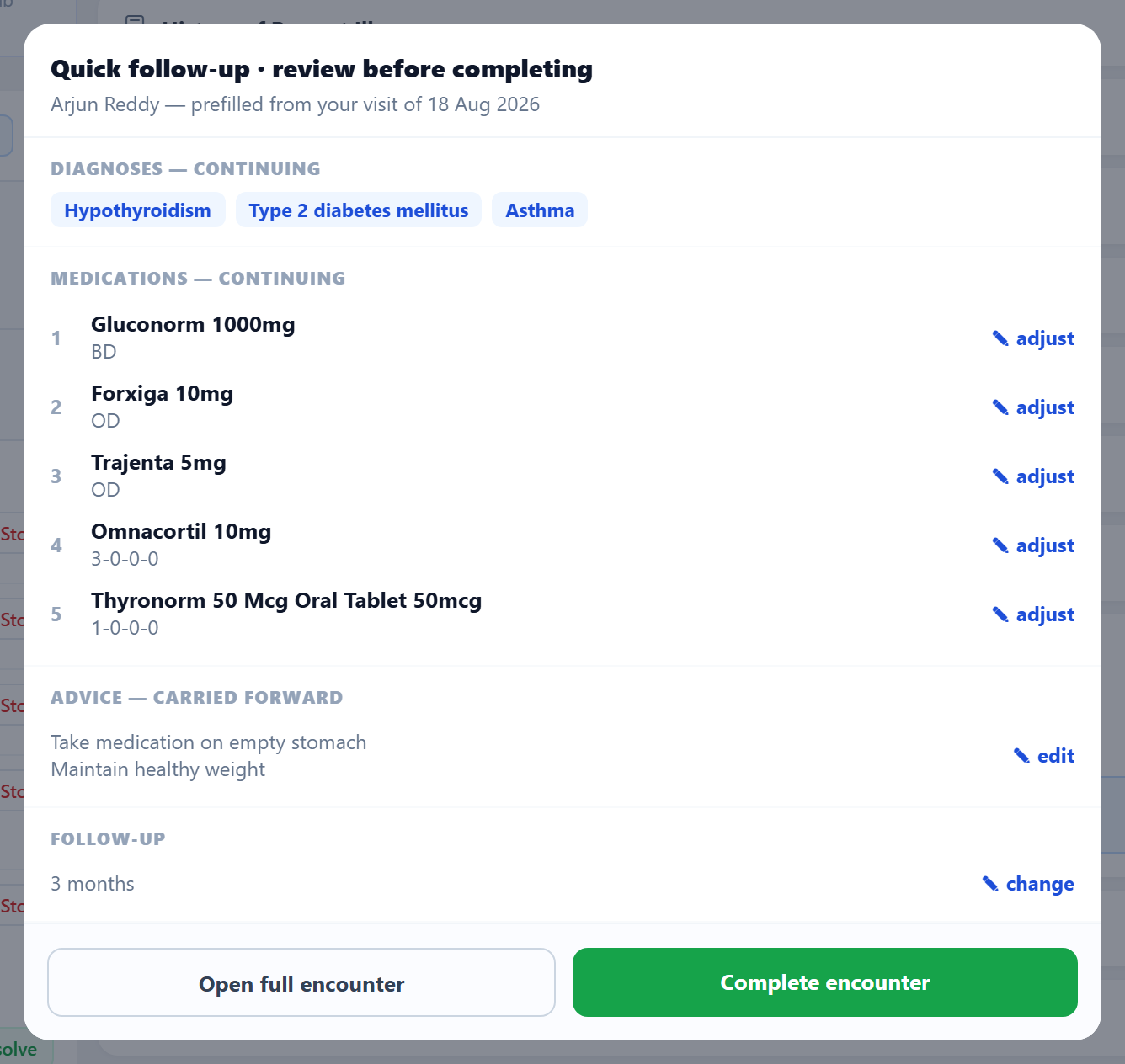
The quick follow-up review card with diagnoses, medicines, advice and follow-up already filled in

One tap produces this. Five continuing medicines with doses, the advice and the follow-up interval - carried forward, ready to check and complete. Watch it in the app →

Aprilfirst visit
Write the full prescription - once · ~2 min

Enter the five diagnoses and eight medicines with dosing chips. Save. It prints clean, branded, and is stored against the patient forever.

May~30 sec
Open the patient → Reissue → change one dose

Everything carries forward. Bump Febuxostat 30 → 40 mg inline, and print. No re-writing diagnoses, no re-writing seven unchanged medicines.

June~30 sec
Open the patient → Reissue → stop one medicine

Tap Stop on Finerenone with a reason, and print. The continuing medicines and diagnoses are already there.

Same care. Same clinical detail. ~90% less effort - and nothing accidentally left out.
Beyond the reissue

Those two changes weren't guesses - the numbers showed them.

Reissuing saves the effort. But the two edits - uptitrating febuxostat and stopping finerenone - came straight from this patient's labs. And at the next visit, the encounter opens with exactly this: what changed, and what the numbers did after - so the response to those two decisions is the first thing you see.

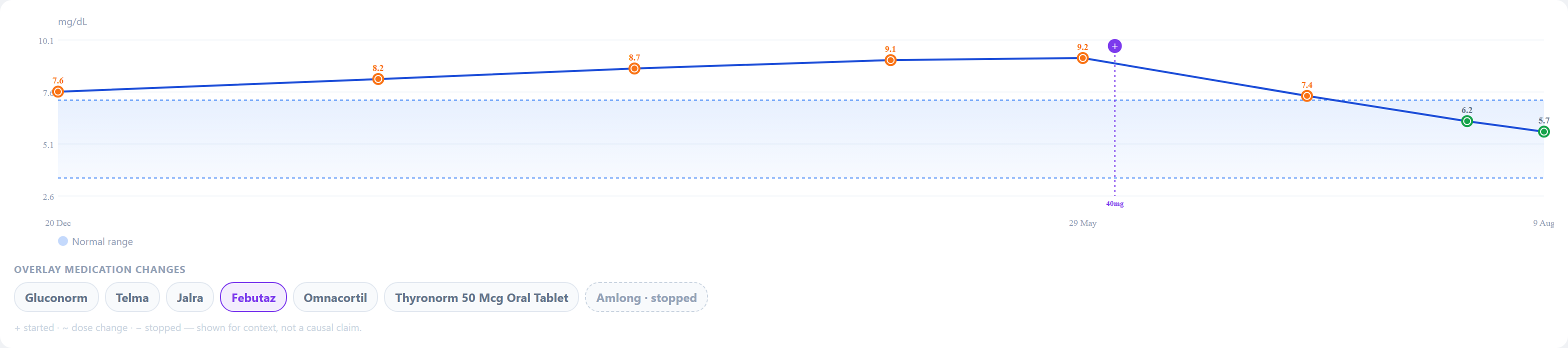
Uric acid trend with the febuxostat start marked on the same axis

The same drug, on this patient's own chart. Febuxostat starts on 29 May; uric acid falls 9.2 → 5.7 mg/dL, into the shaded normal range. Watch it in the app →

Ramesh N. · 71 / M
Patient snapshot
WHAT CHANGED since your visit · May
Febuxostat→ 40mg Finerenone− stopped ~1 month ago · same day
Uric acid7.4 → 5.6within range Potassium6.1 → 5.7above range Creatinine1.9 → 1.8near range top
Active diagnoses
HypertensionAF (post-CVA)HFpEFCOPDHyperuricaemia
Current medications
Febuxostat40 mg · HSRevised 30→40
Finerenone10 mg · ODStopped
Apixaban2.5 mg · BD
Bisoprolol2.5 mg · OD
Furosemide20 mg · morning
Cilnidipine10 mg · BD
Recent labs · renal & metabolic
Uric acid5.6 mg/dL↓ on target
Potassium5.7 mmol/LH · high
Creatinine1.8 mg/dLH · high
eGFR38 mL/minCKD 3b
Photographed from the patient's paper report - values extracted and abnormals flagged, no typing.
Treatment response · your medication changes overlaid
Uric acid mg/dL
target 6.0 7.4 5.6 ~ Apr May Jun
~ Febuxostat 30 → 40 mg · came down 7.4 → 5.6, now under target.
Potassium mmol/L
limit 5.5 4.8 5.2 5.7 Apr May Jun
Finerenone stopped · K⁺ was climbing 4.8 → 5.7, over 5.5.
Serum creatinine mg/dL
upper 1.3 1.4 1.7 2.2 1.8 + Jan Jul
+ Rose on finerenone, eased after stopping 1.4 → 2.2 → 1.8 - still above normal.
+ started · ~ dose change · − stopped - shown for context, not a causal claim.

The febuxostat went up because the uric acid was still high; the finerenone came out because the potassium and creatinine were both climbing - and both eased once it stopped. Every decision, and the numbers behind it, sits in one view at the next visit.

Your repeat patients shouldn't cost you a fresh page every month.

See reissue, inline dose changes, and a clean printed prescription on a real encounter.

Request a demo
Open the demo clinic