The prescribing platform for chronic care

Prescribe in seconds.
Follow the patient for years.

Rxcript is the independent prescribing platform for doctors whose patients come back. Write today's prescription as fast as your pad - then open every follow-up already knowing what worked: the dose you changed, and the number it moved, from the patient's own labs and vitals. Nothing to install, ready your first day.

The demo clinic is a real, seeded practice - three patients with a year of titration history. No signup; look around, you can't break anything.

What greets you when they come back
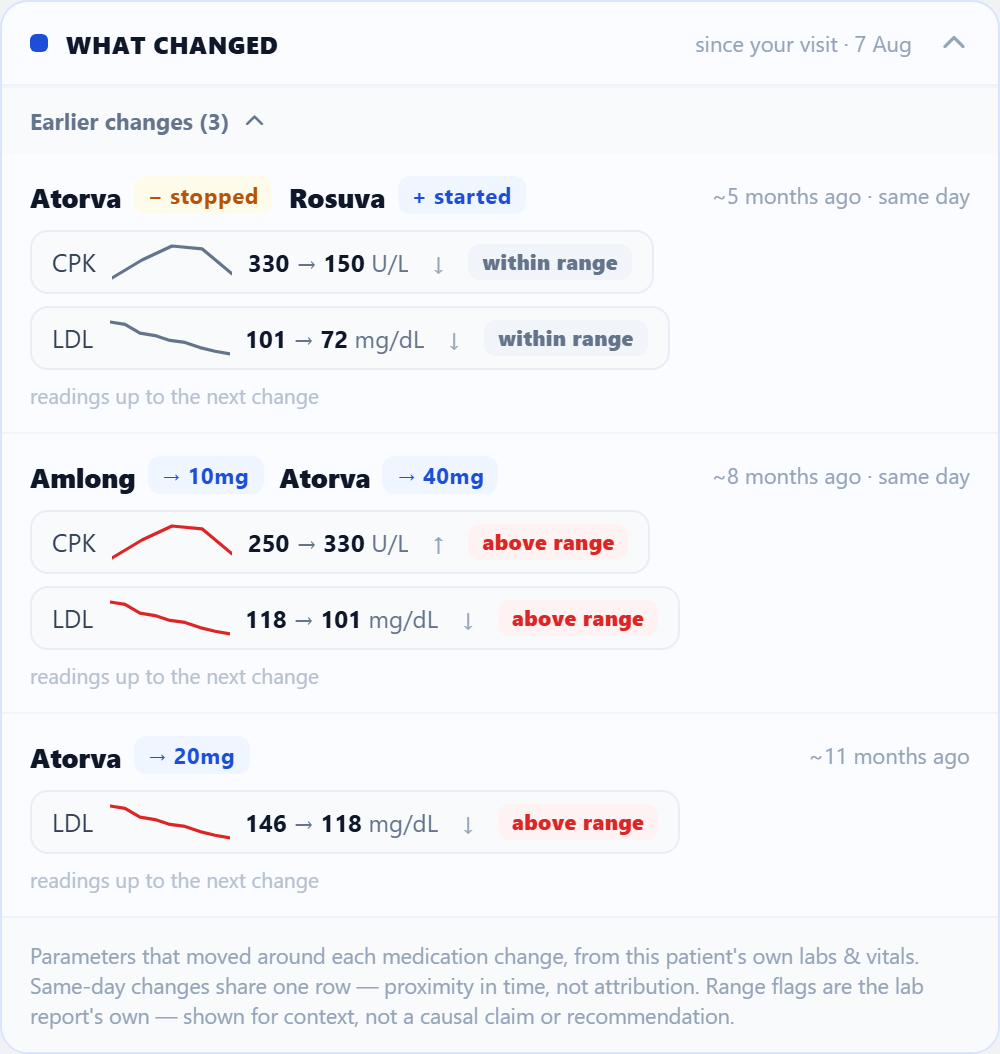
The What Changed panel: each dose change paired with the lab values that moved after it

Every follow-up opens on this. What you changed last time, and what the numbers did after.

Built with Indian doctors
As quick as your pad
Nothing to install
No pharma partnerships
Act one · the moment

Your three o'clock is back. You last saw her in March.

She has a folder. You have four minutes. Somewhere in there is the dose you changed last time, the lab she did in June, and the drug the cardiologist added in between - and none of it is in an order you can read at speed.

So you do what everyone does: you ask her what she's taking, you take her word for it, and you write the same prescription again.

What you can't reconstruct

Which dose you changed, and when.

What you can't find

The lab report from four months ago.

What you never see

What the other doctor changed.

Paper works - until the second visit. You don't need a hospital system. You need the last four months on the screen, before you ask a question.

< 60 sec
to a finished prescription
3 taps
to complete a stable follow-up
One tap
to a patient's full history
A day
to get your clinic running
Act two · the answer

The same visit, with the last four months on screen.

Nothing below is a mock-up. It is the product, in the order you would meet it.

Beat one

Before you ask a question, you already know.

The interval is read for you: the medicines you started, adjusted or stopped last time, and the labs and vitals that moved after each change - from her own reports, not your memory.

  • Anchored to your last visit - older changes fold away.
  • Biggest movers first - with each report's own range flags.
  • Context, not causation - the clinical call stays yours.
The What Changed panel: each dose change paired with the lab values that moved after it

Three dose changes, three answers. Atorvastatin stopped and rosuvastatin started - CPK 330 → 150, LDL 101 → 72, both back within range.

Beat two

And when you change a dose, you see what it did.

Open any lab or vital and the moment you started, changed or stopped each medicine is marked on the same axis. "Did that work?" stops being a memory exercise.

A uric acid trend with the gout drug's start marked on the same axis, the curve falling into the normal range

One patient, eight months. Uric acid climbs to 9.2 mg/dL; the gout drug starts on 29 May; the curve falls to 5.7, into the shaded normal range. See how it works →

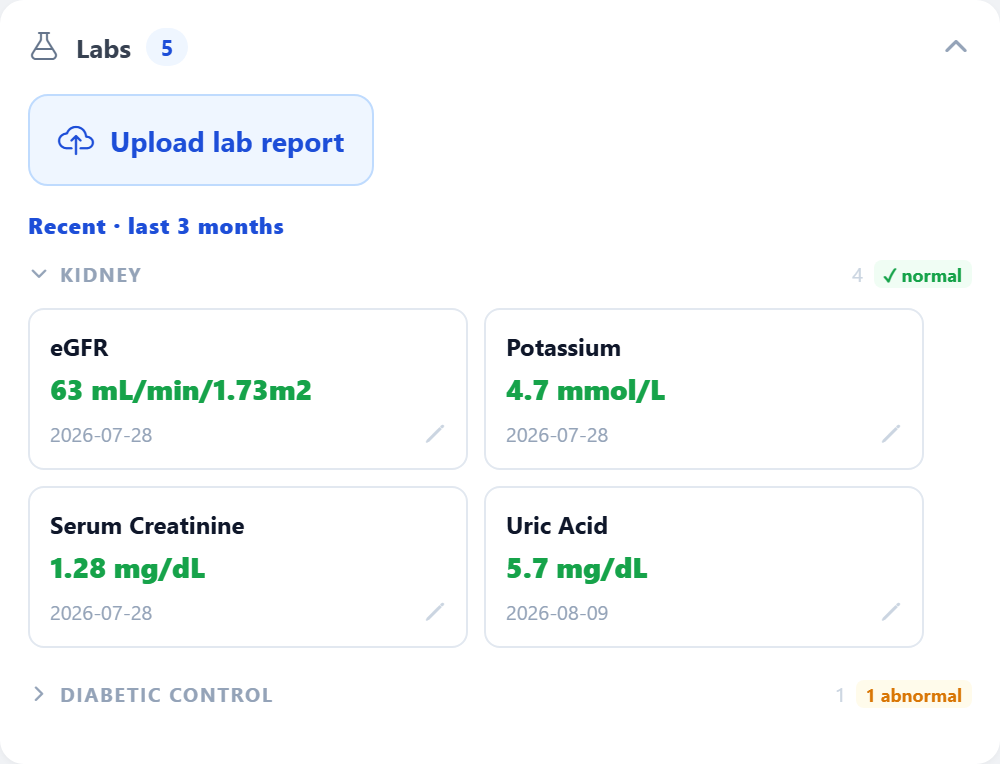
The labs panel: values grouped by panel, dated, and flagged normal or abnormal

Photograph the report; it does the typing. Every value lands dated, grouped by panel and flagged against the report's own ranges - and trends across visits from then on.

Beat three

Her June labs are already in the chart.

The folder in her lap is a photograph away from being data. Rxcript reads the printed report, pulls out every value, flags what is out of range, and keeps it on the same timeline as her medicines. No LIMS, no integration, no typing.

  • Values grouped into the panels you actually read
  • Abnormal results flagged against the report's own reference range
  • Every reading dated and attributed to the lab that issued it
Beat four

Now write it - in about the time the pad would have taken.

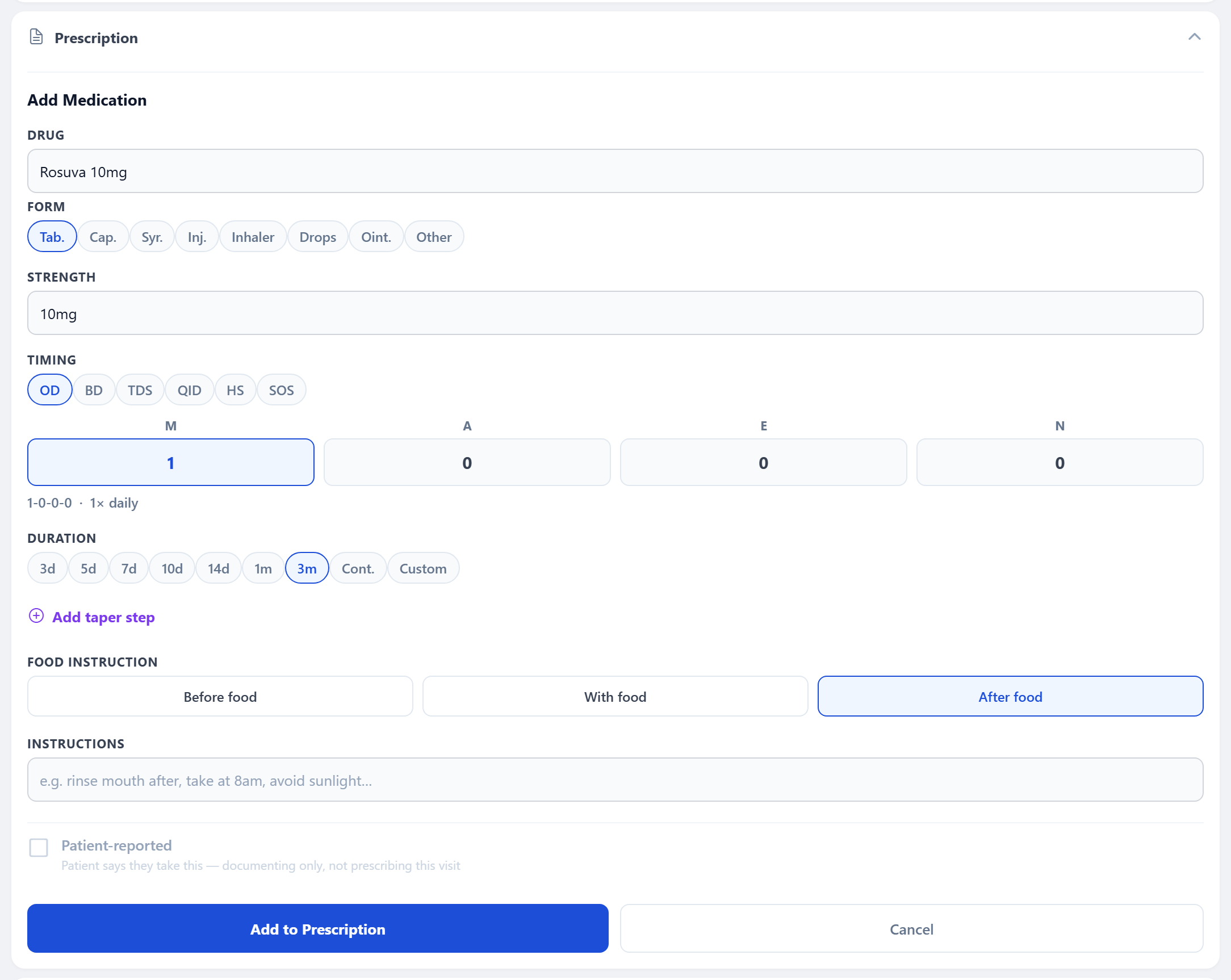
Type the brand you already write; the strength and dose form arrive from the drug record. Dose, duration and food timing are chips, not sentences.

The Add Medication form with brand, strength, dose form, schedule, duration and food timing filled in

One brand, typed. Everything else is a tap. Watch a full consult written - 2 min 04 →

Beat five

The prescription is the only thing that leaves the room.

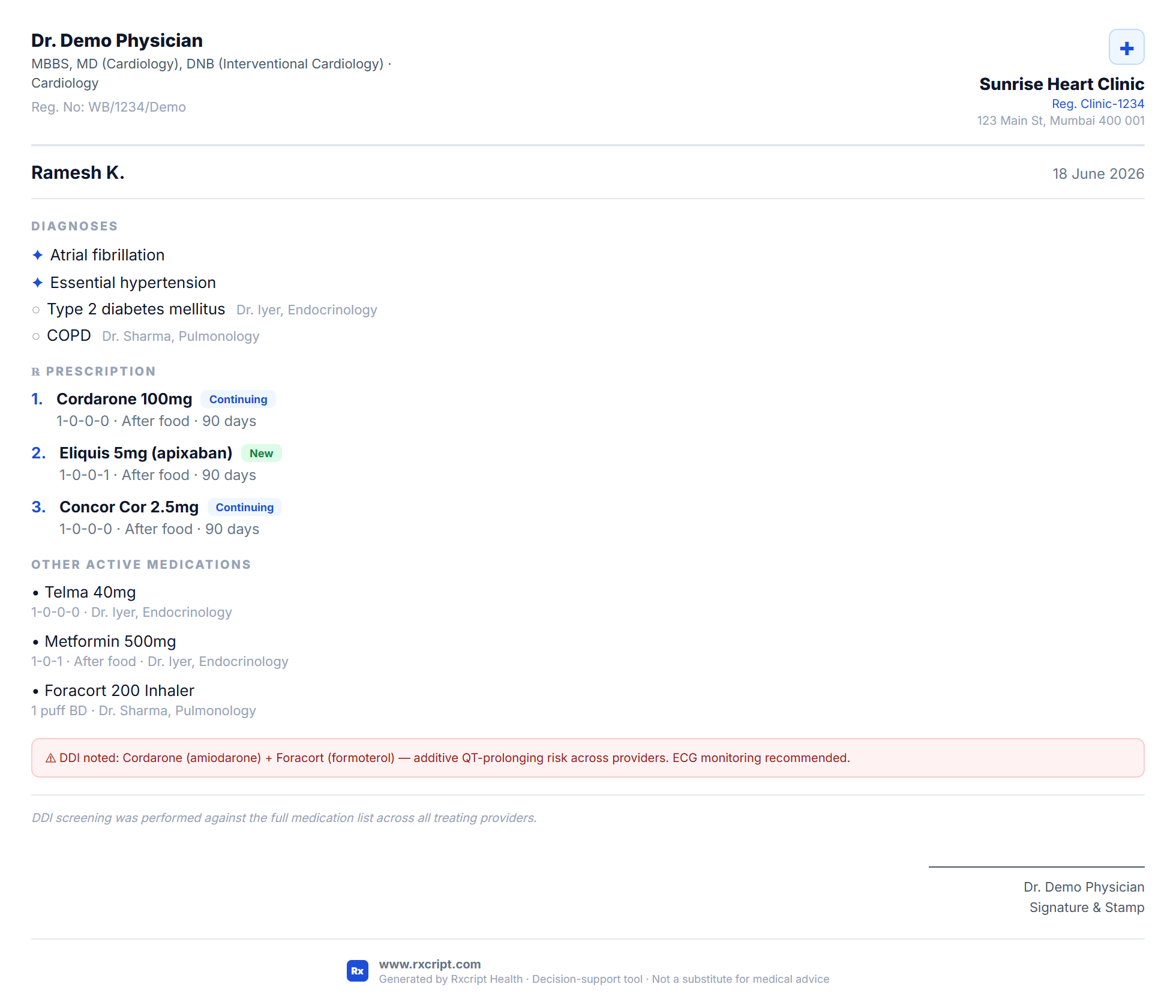
It is what she shows the chemist, keeps in a drawer, and hands to the next doctor who sees her. On paper it is a folded chit that says nothing about the standard of the consult behind it. From Rxcript it carries your clinic's name, every dose written in full, and the reasoning behind what you changed - and it reaches her on WhatsApp before she has left the building.

Your patients cannot judge your clinical reasoning. They can judge what you hand them.

Rxcript printed prescription
Try it on someone else's patients first

Three patients are waiting.

The demo clinic is a real, seeded practice - three chronic-care patients with a year of titration history behind them. No signup, no sales call, nothing to install. You can't break anything, and nothing you do there touches a real record.

1

Open Ramesh Iyer

64, diabetic, hypertensive, stage-3 kidney disease. See what four months of changes look like before you have asked a question.

2

Open his uric acid

Tap the result, put the gout drug on the same axis, and watch where the curve turns.

3

Change a dose and print

Reduce the metformin, complete the visit, and look at the prescription it produces.

Open the demo clinic

About two minutes. No email required.

Act three · and if it doesn't work out?

The questions you're actually asking.

The ones that decide whether a doctor who likes the software actually switches.

What happens to my existing patients?

You don't have to move anything to start. Rxcript works from the first patient who walks in: a returning patient becomes a full record the moment you open their first encounter, and their history builds from there.

If you're coming off another system and want your patient list brought across, talk to us before you start and we'll tell you honestly what can and can't be moved.

Will it slow me down when forty patients are waiting?

The design target isn't one fast prescription, it's a full OPD. A stable follow-up - most of a chronic-care list - is a glance and three taps, because last visit's diagnoses, medicines, advice and follow-up interval carry forward onto one review card.

The honest answer: your first day will be slower than your pad, and by the end of the first week the repeat visits are faster. Open the demo clinic and time it yourself.

What if the internet drops mid-clinic?

Rxcript runs in the browser and needs a connection to save an encounter. Nothing is lost from a completed visit - once a prescription is saved it's on the server and available from any device you log in from.

If your clinic's connection is unreliable, tell us on the call and we'll be straight with you about whether that's workable today.

Is a digital prescription legally sound?

Every encounter is written as an immutable, point-in-time record: who diagnosed, who prescribed, what was adjusted or stopped, and why. Diagnoses use WHO ICD-11; medicines use the NRCES / SNOMED CT coding India's ABDM is built on.

That record is more defensible than a handwritten chit, because it can be produced exactly as it stood on the day. See how records are stored and isolated →

What does day one actually look like?

There's nothing to install. You log in, your clinic's name and address go onto the letterhead, and you prescribe. Most doctors are writing on it the same day; front-desk staff get their own logins when you want booking and check-in.

Your drug list is already there - India's brands, searchable by brand or molecule - so there's nothing to type in before you start.

And if I leave?

Your records export with you, and pausing a subscription deletes nothing. No lock-in is a feature we're happy to be held to - it's on the pricing page in writing.

Independent by design

The only agenda on your screen is your patient's.

Rxcript takes nothing from pharma - so nothing on your screen is paid to be there. It's not a slogan; it changes what you see and trust every time you prescribe.

🧼

A clean clinical workspace

No pop-ups, no "suggested" brand-names nudged into your prescription to please a sponsor. What's on screen is what you chose to write.

📖

Guidance you can trust

Interaction and safety alerts are drawn from peer-reviewed clinical evidence, not sponsored formularies. The medicine that surfaces first is the one you favourited.

🔒

Your patients aren't the product

We sell nothing about your patients - no phone numbers to diagnostic labs, no prescribing data to brands. Your records stay encrypted, yours, and exportable.

The rest of it

Everything else you'd expect, and nothing you wouldn't.

The clinical core of a practice, done properly - with no billing silos or insurance coding to wade through.

🗂️

Patient history, saved

Every visit, diagnosis and medicine in one place. Find a returning patient in one tap - walk-in or registered.

⚖️

A record that stands behind you

Immutable, point-in-time encounters: who prescribed what, what was adjusted or stopped, and why.

🛡️

Quietly keeps you safe

Duplicate medicines and risky combinations are flagged in the background - across every doctor treating the patient, including ones you've never met.

🎙️

Dictate, don't type

Speak complaints, history and advice; review the structured draft and confirm with one tap. Your hands stay on the patient.

It learns how you prescribe

Your most-used diagnoses and medicines rise to the top, and the form already speaks your specialty.

🏥

Built for a clinic, too

Shared records across your doctors, clinic protocols and preferred brands, online booking, and a front desk that runs the queue.

See it in practice

Three months. One cardiac patient. Two real changes.

A cardiologist hand-wrote the same five diagnoses and eight medicines every month - when only a dose tweak and one stopped drug actually changed. See how Rxcript turns that into a 30-second reissue.

Read the case →

See your own patients the way Rxcript sees them.

Open the demo clinic and look around first - two minutes, and it asks nothing of you. When you want to talk, bring one complex case and we'll open it the way you would at the next visit.

Open the demo clinic